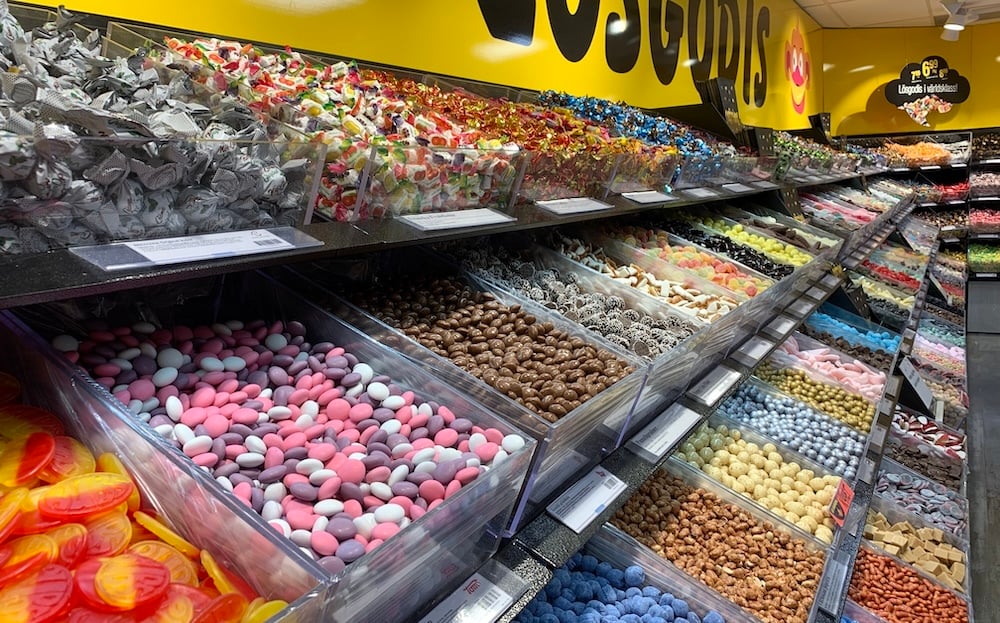
In Sweden, we are passionate about candy. Salty licorice, sour gummies, Plopp chocolate bars. Visitors to our country delight in the variety of colors, shapes, and flavors available. And we don’t just make great candy, we buy and eat great candy… a lot of great candy (an average of 15 kilograms (about 33 pounds) of candy per person per year)*.
We are so passionate about candy that every grocery store carries a dizzying variety of it, in the Lösgodis section, meaning “loose candy.” Go here, and you can fill your bag with a little of this, a little of that. Get some chocolate-covered marshmallows for your son and Bubs foam candies for your daughter, salty licorice pieces for yourself, and a large quantity of Kexchoklad for the office party. Throw in some Ahlgren’s bilar for your friend, and you’ve got exactly what you and yours need.
When you’ve made your selections, you weigh the bag and pay for it as a batch. Loose candy.
Most Sales Software Today Operates Like a US Grocery Store, lacking the Lösgodis
Imagine if you wanted that same variety of candies, but a traditional US grocery store was your only option for purchasing. In order to get the same variety of candy, you would have to buy a full bag of each. No mixing and matching. You’d spend a lot more money and fill up your car with candy you don’t need. Or, you could decide to only buy one bag. You’d make one person very happy, and everyone would know who your favorite child was.
We’ve all been overpaying for bloated software for so long, it’s hard to remember that it doesn’t have to be that way.
This is what happens when you purchase sales software with stiffly limited pricing tiers. You buy the lowest cost option, and you get most of what you need, minus a few things you really want. Upgrade to get those things, and suddenly you have a large number of options you didn’t want, but still have to pay for. Your users are overwhelmed with a chaotic mess of options, like a car full of candy bags. Or they don’t have everything they actually need to do their jobs.
Buy one platform and demand everyone make do, and everyone knows which stakeholders you actually care about.
There’s no lösgodis for features.
Imagine If Each Grocer Only Carried One Type of Candy
Imagine an even worse scenario: Every type of candy is available only in its own dedicated store. Now, in order to get a variety, you have to wander the whole city, from store to store to store, and buy a full bag of candy at each one.
This is what happens when you have to buy point solutions from multiple vendors to get the features you want, and then you bolt them together to try to make it work. No lösgodis, only chaos.
Enough Already
It’s time. You should be able to pick and choose which software features you need for your team. For instance, in Membrain, if all you need is our prospecting module, you get (and pay for) our prospecting module (our CRM database comes for free, kind of like the bag you need to place your lösgodis in). If your sales team needs prospecting and opportunity management, but your customer success team only needs delivery Flows, that’s what they get, and what you pay for. If you need everything, including the Account Growth module for account planning and overarching planning, that’s what you get.
You never pay for options you don’t need. And you never clutter salespeople’s workflow with features they won’t use. You can even customize the views different teams have, so that they only see what’s relevant to their job. And that’s how it should be.
How to Lösgodis Your Tech Stack
We’ve all been overpaying for bloated software for so long, it’s hard to remember that it doesn’t have to be that way. We can make the madness stop. Here are some tips for “lösgodis-ing” your sales software:
- Audit your current tech stack
Which features do your teams use? What don’t they use? Are you overpaying for a CRM built as a digital Rolodex and spending a fortune trying to convert it into a Formula 1 racing car? Survey your people to find out what features they love and what features seem to be in the way.
- Evaluate your gaps, overlaps, and excesses
Where does your current stack fall flat on features? Where are there overlaps between platforms? What excessive functionality do you want to trim away? Challenge your vendors. Ask for flexible pricing. Demand that you pay only what you need. Ask them to take extra features out of the software to decrease distractions. Ask them to help you right-size instead of simply bloating your tech stack.
- Think modular
When evaluating new sales tools, consider how flexible they are. Do they contain extra features, and can you turn those off? Are you paying for more than you need? Can the platform scale with you without forcing unnecessary features or costs? Does the pricing model allow you to grow in a rightsized way, paying only for what you need today, while still supporting your future needs?
The more we collectively demand tech that can be right-sized according to our needs, the more the market will respond. And the more you evaluate what you actually need and pare away what it doesn’t, the more efficient and effective your organization will be.
Do you have particular platforms you really wish would get on board with lösgodis? Any you think are doing a great job of this? Tell me in the comments.